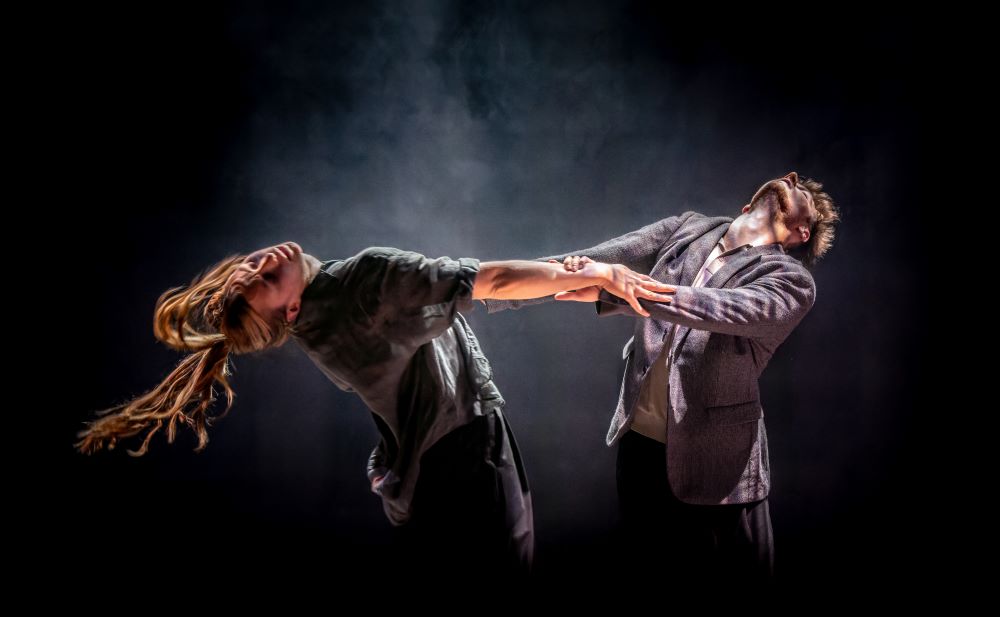
With Zofia Żwirblińska, winner of the open call for a chamber premiere as part of the Spaces of Theatre – Dance – Kraków program, we discuss her latest performance “Foolish Goose” (“Głupia gęś”), imposter syndrome, and… controlled catastrophes.
70% of people at least once in their lives have felt that their skills were insufficient and that they didn’t deserve their position. When did you last feel that way?
Zofia Żwirblińska: To be honest, I feel it quite often. Especially now, while working on this performance, accompanied by many questions, challenges, and doubts piling up day by day.
Imposter syndrome—a state of permanent self-doubt… Do you think it’s a disease of 21st-century civilization?
Z.Ż.: Among the people in my circle, this topic comes up surprisingly often. And I don’t just mean in the art world, but people from entirely different backgrounds. But is it a disease? I don’t know, but it is certainly being spoken about more and more loudly.
Your latest performance, “Foolish Goose,” is being created within the Spaces of Theatre – Dance – Kraków program. You won the open call for a chamber premiere. What did you think when you found out the competition results? “I pulled it off” or “I deserved it”?
Z.Ż.: I think I was, and still am, closer to saying “I deserved it.” The application I submitted was prepared very thoroughly, consciously, and carefully. I’ve been working on this project for a long time, so I knew I wasn’t submitting a dry concept, but a living, multifaceted material that would either resonate with the committee or not. I was certainly surprised, because people my age rarely win such competitions. All the more, I am grateful for the trust.
The performance will feature autobiographical elements. Is “Foolish Goose” your personal act of courage?
Z.Ż.: You could say that, although I wouldn’t want to put that much pressure on myself. Uncovering one’s own experiences and weaving autobiographical threads into the script undoubtedly requires stepping outside a certain comfort zone. However, for me, the greatest act of courage isn’t so much the one-hour piece that the audience will see on stage, but the entire creative process. I’m talking about the choices made right at the beginning of this path, the ones I’m making now, and those waiting for me up until the premiere and beyond. The very format of the performance—an hour spent alone on stage—is a huge challenge. On top of that, there’s the responsibility of seeing the project through from start to finish, managing the whole situation wisely, creative exchange with the invited artists—Patrycja, Ola, and Michał—ensuring the team’s comfort, and countless other matters. It is in the sum of these small, daily steps that I would look for that courage.
Although the performance is deeply personal, you worked on its shape with dramaturg Patrycja Kowańska, known from the duo Gruba i Głupia (Fat and Stupid). How did your collaboration work in practice to turn personal experiences into the universal language of theatre?
Z.Ż.: I invited Patrycja to collaborate when I managed to secure a cultural scholarship from the City of Gdańsk. At that stage, I had accumulated a lot of images, signs, landscapes, and words. Patrycja helped me emerge from that intuitively gathered lake of inspiration and precisely name the subject. Since I don’t like to expose myself directly, and the artistic symbols and tools I choose can be quite mysterious, our work primarily focused on properly tuning the communication with the audience. The point was to make those personal experiences, which I had hidden under a web of contrasting symbols, decodable for the viewer. In short: we turned inner “sobbing” (łkanie) into “lying” (kłamanie), and that’s how “Foolish Goose” (“Głupia gęś”) was born.
You point out that in the performance, embarrassment/humiliation becomes deliberate artistic material. How hard was it to design your own controlled “catastrophe”?
Z.Ż.: I’ll start by saying that we treat the concept of embarrassment quite provocatively in this show. The very vision of designing—let’s call it—a “catastrophe” was extremely liberating for me. Though will it really be a catastrophe? Contrary to appearances, the task didn’t turn out to be that hard. I knew that working with Patrycja, I could fully unlock my creativity and just go wild. By playing with embarrassment, in a strange and non-obvious way, I opened a doorway to fulfilling my little stage dreams. But I won’t reveal any more—you’ll see for yourselves when you come to the show.
The goose in your performance isn’t just a metaphor. Why did this particular animal become the figure of embarrassment and of a body that “no longer wants to be well-behaved”?
Z.Ż.: The goose waddled up to me a while ago. In culture, this animal carries a rather specific, mostly negative connotation. Since I really like playing with words and selecting them carefully, I knew right away that there was huge semantic and stage potential hidden here. When the idea for a performance touching on imposter syndrome emerged, the goose became the ideal starting point for working with a body immersed in a constant sense of self-doubt. After all, “foolish goose” (głupia gęś) is a colloquial, dismissive term for a woman perceived as naive or mindless. At the same time, she has an incredible, raw physicality. She is loud, she hisses, she doesn’t care about elegance. On stage, this figure becomes a rescue—allowing the body to shed the corset of propriety and simply break free.
How did you manage to translate the psychosis of imposter syndrome into the language of the body?
Z.Ż.: I’ll start by saying that I treat my body on stage—and in daily practice—like an object. I approach it with a detached perspective, which gives me distance. Unpacking imposter syndrome, working with extremely soft and close material, I adopted an equally analytical strategy. Together with Patrycja, we focused first on breaking down its components and then on finding stage situations that would enter into a dialogue with them. The movement language itself emerged quite organically. Unlike words, which are always constrained by certain frameworks and definitions, movement has no limits—it is free, and therefore malleable. Most of the choreographic material crystallized from this freedom, born out of improvisation framed by specific premises, as well as experiments based on absurd ideas.
Is the artistic environment, with its constant pressure to be “enough,” an ideal breeding ground for imposter syndrome?
Z.Ż.: That pressure certainly doesn’t help. The art world relies heavily on a constant climb upwards and continuous, often involuntary comparisons. Especially at the beginning of the journey, it’s rarely just about you—in auditions or casting calls, it’s always a setup of: you or someone else. In such a reality, the notion of being “enough” comes up constantly, and I think that’s what often generates all these doubts. On top of that, there’s the entire unstable background of our work: few full-time positions in theatres, lack of insurance, issues with pensions for artists… but that’s a topic for a completely different conversation.
What words would an artist need to hear from an audience member to fully believe, without guilt, that they are in the right place?
Z.Ż.: It might sound a bit cliché, but if someone comes up after the show and says even a simple “thank you,” that already means a lot. We rarely talk nowadays—the performance ends, and everyone just scatters. I certainly miss those conversations with the audience very much.
The premiere of “Foolish Goose” takes place on August 29th at 7:00 PM on our theatre’s stage.