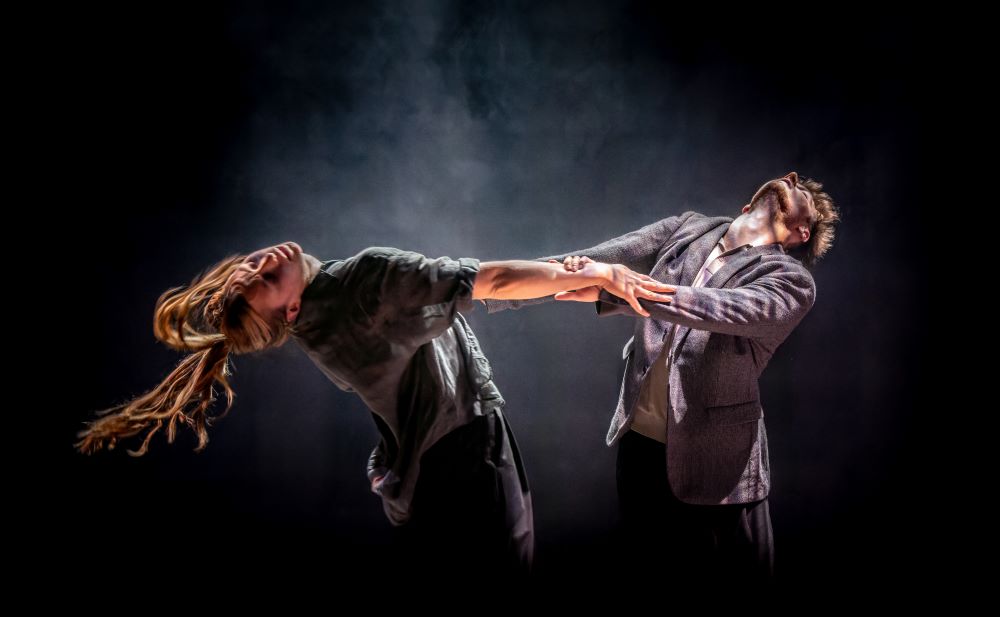
With Aleksandra Nowakowska and Andrzej Józefczyk, winners of the 2nd edition of the Body and Time Festival, we discuss their latest performance 300-millisecond archives, body memory, and the obsession with archiving.
In an era where every aspect of life is recorded, does dance still remain something that cannot be archived?
Aleksandra Nowakowska: Our bodies are archives of movements, gestures, and situations, and it is this database that we draw from when creating dance. The question of repertoire—a more personal one—is part of our creative process. When choreographing, we consider whether repetition is possible in dance or if there is only a copy; whether we are able to teach another body our own characteristic gestures. On one hand, it is impossible to archive dance; on the other, every dance relies on past movements, memory, teachers, and techniques.
So, as they say… it’s complicated.
Andrzej Józefczyk: From a signal domain perspective, dance is exceptionally complex. It varies greatly between bodies, and it’s hard to find a single way or approach to collect all the crucial data from which it could be reconstructed. It’s even hard for me to imagine how such a generalization could work, though I think certain qualities can be successfully recorded.
Your latest performance 300-millisecond archives is based on the continuous processing of live sound and movement. How much of what we will see on stage is precisely set, and how much is pure improvisation?
A.N.: We are curious about the performance as an archive that expands with every show. We create sounds by recording rehearsals, sampling the theatre building, and keeping micro-diaries. In some scenes, we structure precise choreographies; in others, we rely on improvisation.
It’s getting more and more interesting…
A.J.: We wouldn’t want to reveal too much, but from my perspective, the entire performance—the performers, the audience, the building—is one single system. The result will be organic, dependent on each of its elements, and that is the core concept.
Does this constant looping and processing give you a sense of artistic freedom, or does it become a stage trap?
A.N.: There is an element of obsession to it, but the difference between consecutive repetitions is also alluring.
A.J.: I’m reporting from the depths of the trap, unfortunately…
Trap and obsession. Sounds like 21st-century reality. Today, I feel like we view the world almost exclusively through a smartphone screen. Why have we gone crazy over archiving?
A.J.: We can observe the drive to collect and organize data for a good few centuries, starting with organizing printed books into libraries. I think widespread access to recording, transmitting, and consuming data technology has made our lives “data-oriented,” so to speak, but the tendency is rooted in us. Information is leverage. Today, it’s worth noting that we are at an interesting turning point: the gathered data isn’t just meant for human consumption, but is archived and organized so algorithms can easily process it and generate new content in the image of what was previously collected—that’s a relative novelty.
Speaking of novelties. Ola, in 300-millisecond archives you are responsible for the concept and are also one of the performers. Is it difficult to combine the creator’s analytical eye with direct, physical involvement on stage?
A.N.: Definitely! At the same time, the subject is very close to me, and as a performer, it is an absolute pleasure to dive into the topic of recordings, memory, and archiving.
Two other performers will also appear on stage: Natalia Dinges and Ana Kuszarecka. Was that an obvious choice?
A.N.: Natalia and I share a connection through the Dance Theatre Department in Bytom; we also worked together on Maciej Gorczyński’s performance A Report to an Academy, where I served as the dramaturg. I met Ana recently and sensed similarities in movement and energy among the three of us. I’m really looking forward to working with the girls.
Your latest performance fits perfectly into the framework of the Body and Time Festival. But let’s go back to 2025. What were your thoughts when SPEECHLESS won the main prize—the opportunity to produce your own show on the stage of Teatr KTO?
A.N.: SPEECHLESS is an important show for me, built with independent persistence over several years. It was a great honor, and I was rendered completely speechless when I heard the verdict. In SPEECHLESS, we consistently try to follow the performance’s language: working with the live-processed sound of dance and voice, but also the processing of gesture. There is a certain minimalism and—though it might be too big a word—experimentation to it, and I’m glad it was appreciated.
A.J.: I remember feeling immense gratitude and joy at the news of working on a new show.
Just like SPEECHLESS, your latest premiere addresses sound, but in a different way… When and under what circumstances was the idea for 300-millisecond archives born?
A.N.: My initial inspiration was a concert of recordings by Dorota Błaszczak, who is associated with the Polish Radio Archive and works with ecoacoustics and data sonification. She compressed and processed hours of recordings into several-minute pieces. I was fascinated by her refusal to omit any sound—an attempt to transcend one’s own limitations using a recording as a memory prosthesis. I began to wonder if a similar gesture could be made toward dance and movement. I asked her for a conversation, and her perspective on sound and recordings captivated me—I wanted to translate that way of thinking into something familiar to me.
And so the idea of sonifying datasets emerged?
A.J.: The scale of collecting, archiving, and generalizing datasets surpasses human perception limits. Information has lost a form that is accessible to us, but for me, the most interesting parts are the interfaces between humans and such datasets. Hence the idea of sonifying datasets of movement and trajectories.
What was your first inspiration?
A.J.: The piece Calculating Empires by Kate Crawford and Vladan Joler really fired up my imagination while preparing for the performance. It’s a massive infographic attempting to trace the evolution—or perhaps the genealogy—of various technological fields in the context of acquiring and consolidating power. The first time I saw it, I was moved by the thoroughness of their work. The second time, a year later, it filled me with anxiety.
During the October premiere of 300-millisecond archives, will the audience see an expression of love for the fleeting moment, or rather nostalgia for what has passed?
A.N.: I’m less interested in nostalgia and more in the need to break free from our own limited temporality. The ways we gather data, remember, and learn, but also the motivation to store and leave traces behind, are the components that make up this performance.
The premiere of 300-millisecond archives takes place on October 3rd at 7:00 PM on our theatre’s stage.